Many people assume desire is only about attraction.
In real life, it is often more complicated than that.
Sometimes a person wants closeness, wants connection, and even loves their partner deeply, yet still struggles to relax into intimacy. The problem is not always the relationship. It is not always libido either. Sometimes the biggest barrier is self-consciousness.
That is where body image enters the picture.
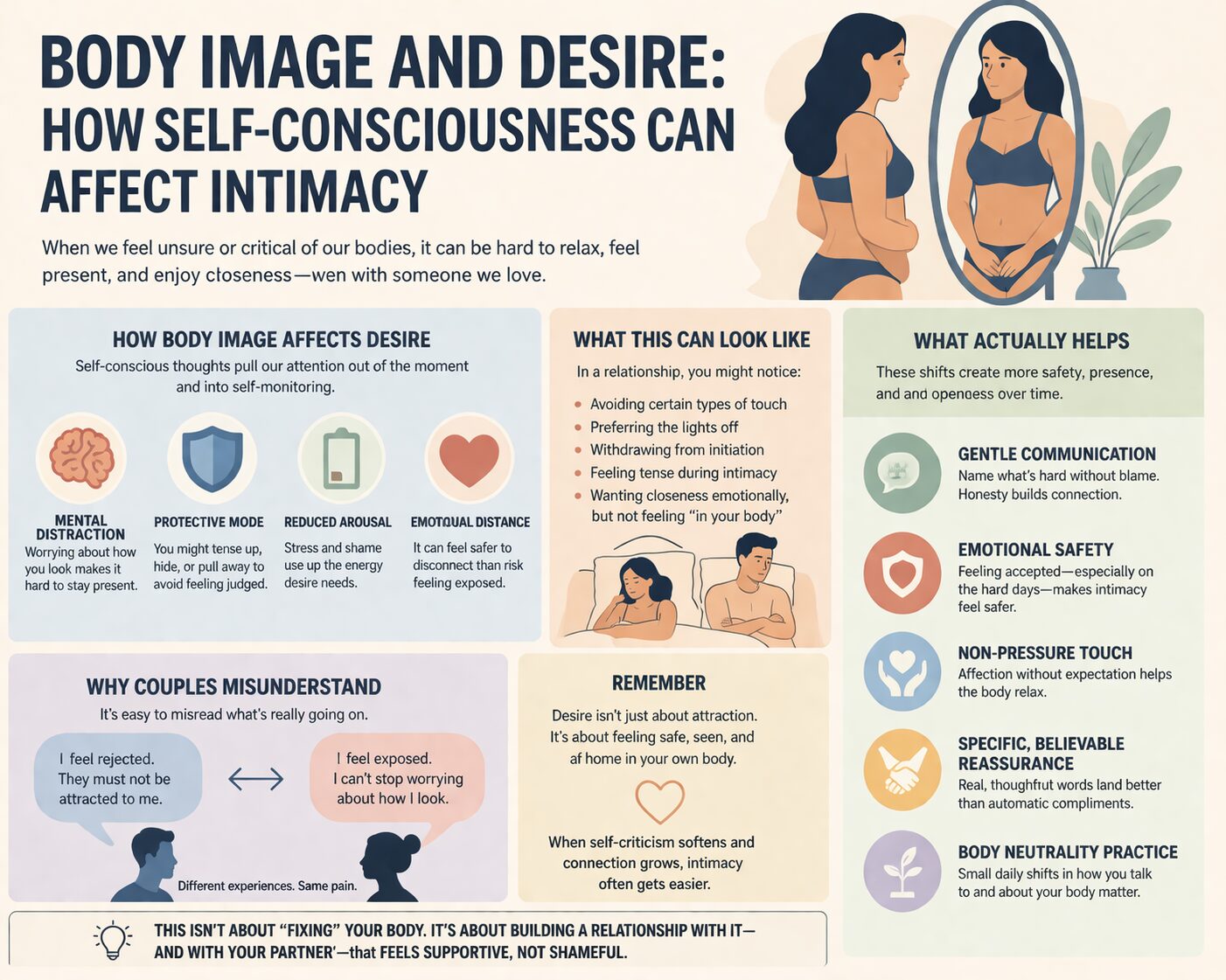
Body image is not just about liking or disliking how you look. It is about how safe, comfortable, visible, and at ease you feel inside your own body. When that relationship is strained, desire can become harder to access. Intimacy may feel less like pleasure and more like exposure.
This matters because many couples misunderstand what is happening. One partner may think, “They are not interested in me.” The other may be thinking, “I cannot stop worrying about how I look, how I move, or how I am being seen.” Both people can care. Both people can want closeness. Yet the experience can still become tense.
Quick Answer
Body image can affect desire because self-consciousness makes it harder to feel present, relaxed, and open during intimacy. When someone feels distracted by insecurity, criticism toward their own body, or fear of being judged, connection often becomes harder to access. Rebuilding desire in that situation usually starts with less shame, more emotional safety, gentler communication, and a more supportive relationship with the body itself.
Key Takeaways
- Body image and desire are closely connected for many adults.
- Self-consciousness can block presence even when attraction is still there.
- Feeling loved is not always the same as feeling comfortable in your body.
- Pressure, comparison, and criticism usually make the problem worse.
- Confidence often rebuilds through safety, honesty, and small shifts, not perfection.
Table of Contents
- What body image has to do with desire
- Why self-consciousness affects intimacy so strongly
- What this looks like in real relationships
- Why couples often misunderstand it
- What actually helps
- Mistakes that make it worse
- Consent, reassurance, and emotional safety
- When to look deeper
- FAQ
- Final takeaway
1) What Body Image Has to Do With Desire
Desire usually works best when a person can feel present in their body.
However, body image struggles pull attention in the opposite direction. Instead of being in the moment, someone may be monitoring themselves from the outside. They may be thinking about their stomach, their skin, their weight, their posture, their scars, their aging, or whether their partner notices every detail they dislike.
That kind of internal noise changes intimacy.
It becomes harder to relax. Harder to enjoy touch. Harder to stay emotionally open. As a result, desire may feel weaker, slower, or more fragile. Not because attraction is gone, but because self-consciousness is taking up too much space.
This is one reason people can sincerely love their partner and still struggle with closeness. The tension may not be about the relationship at all. It may be about what it feels like to be seen.
2) Why Self-Consciousness Affects Intimacy So Strongly
Intimacy asks for presence.
It asks for a certain level of comfort, softness, and openness. Yet self-consciousness creates the opposite state. It pulls a person into monitoring, bracing, comparing, hiding, or performing.
That is exhausting.
If someone is busy thinking:
- “Do I look unattractive from this angle?”
- “What if they notice this part of my body?”
- “I do not feel sexy at all.”
- “I hope they are not comparing me to someone else.”
then desire often has much less room to grow.
This also helps explain why body image issues can affect people even in loving relationships. A caring partner can help, of course. Still, reassurance does not always instantly erase a deeply critical inner voice. If someone has learned to see their body through judgment, intimacy may still feel emotionally risky.
3) What This Looks Like in Real Relationships
Sometimes body image struggles are obvious. Other times, they show up quietly.
- One partner avoids certain kinds of touch.
- They keep the lights off every time.
- They avoid initiation, even when they want closeness.
- They seem tense instead of relaxed during affectionate moments.
- They pull away after compliments because they do not believe them.
- They want intimacy emotionally, but seem shut down physically.
In some relationships, this becomes a painful loop. The self-conscious partner withdraws because they feel exposed. The other partner notices distance and feels rejected. Then both people become more anxious. As that tension grows, intimacy can start to feel heavy for everyone involved.
That is why the issue often gets mislabeled. It may look like low desire on the surface. Underneath, it may be fear, shame, comparison, or the inability to feel at home in one’s own body.
4) Why Couples Often Misunderstand It
This topic is easy to misread because the outside behavior can look like disinterest.
One partner may think:
- “They never seem relaxed with me.”
- “Maybe they are not attracted to me.”
- “Why do they always pull away?”
Meanwhile, the other person may be thinking:
- “I feel exposed.”
- “I do not know how to stop criticizing myself.”
- “I want closeness, but I do not feel good in my body.”
Both sides can feel hurt at the same time.
This is also why body image often overlaps with other intimacy patterns. A person who feels self-conscious may seem less spontaneous, which can look like low libido. They may need more emotional safety, which can resemble responsive desire. They may avoid intimacy more during stressful seasons, which can connect to mental load or burnout.
If that sounds familiar, this topic fits closely with Responsive Desire: Why You Don’t Need to Feel Turned On Instantly, Mental Load and Desire: Why Being Overwhelmed Can Shut Intimacy Down, and Feeling Wanted in a Relationship: Why It Matters and How to Rebuild It.
5) What Actually Helps
Name the real issue gently
Many people hide body image pain behind vaguer words like “I’m just tired” or “I’m not in the mood.” Sometimes that is true. Still, when self-consciousness is the deeper issue, naming it can bring relief.
That may sound like:
- “I care about us, but I’ve been feeling really self-conscious in my body.”
- “This is not about you not being attractive to me.”
- “I want closeness, but I’ve been struggling to feel comfortable being seen.”
That kind of honesty can change the entire conversation.
Reduce performance pressure
When intimacy starts to feel like a test of confidence, desire often gets weaker. Pressure to “be sexy,” “relax,” or “just stop overthinking” usually backfires.
A better approach is to create more ease and less performance. More warmth. More patience. More room for the body to exist without being judged.
Focus on safety, not perfection
People often think confidence means feeling flawless. It does not.
Very often, what helps most is not becoming suddenly perfectly confident. It is feeling safe enough to be imperfect without fear of criticism, mockery, or emotional withdrawal.
That shift matters because emotional safety reduces self-protection. And when self-protection eases, desire often has more room to return.
Ask what actually helps
Different people need different things.
- Some feel better with slower pacing.
- Some need more affectionate touch outside intimate moments.
- Some respond well to genuine compliments.
- Some need less focus on appearance and more focus on connection.
- Some need reassurance that is consistent, not dramatic.
That is why curiosity matters more than assumptions.
Support the whole person, not only the symptom
Sometimes body image pain is connected to bigger issues such as stress, aging, pregnancy, postpartum changes, illness, medication, comparison culture, or long-standing shame. If so, the answer is rarely just “more compliments.” The deeper goal is helping the person feel more supported inside their full reality.
If talking about this feels difficult, How to Talk About Sex With Your Partner Without Feeling Awkward can help you open the subject more gently.
6) Mistakes That Make It Worse
Mistake 1: Taking it personally too fast
It is understandable to feel hurt when intimacy changes. Still, if body image is the real issue, interpreting everything as rejection can add even more pressure.
Mistake 2: Giving reassurance that feels generic
Some reassurance helps. However, if it feels automatic, forced, or dismissive, it may not land. People usually respond better to warmth that feels specific and believable.
Mistake 3: Minimizing the issue
Saying “You look fine” or “You are overthinking it” may sound practical, but it often makes someone feel less understood. The struggle is not always about logic. It is about how the body feels from the inside.
Mistake 4: Turning intimacy into proof
If one partner starts expecting intimacy to constantly prove love, attraction, or reassurance, the whole topic can become overloaded. That tends to create more tension, not more confidence.
Mistake 5: Ignoring the wider emotional pattern
Body image pain often gets worse when stress is high, affection is low, communication is poor, or the relationship already feels tense. If the environment around intimacy stays cold or pressured, self-consciousness usually gets stronger.
7) Consent, Reassurance, and Emotional Safety
This part matters deeply.
Body image struggles should never be used as a reason to pressure someone into “getting over it.” Understanding the issue is supposed to create compassion, not obligation.
A healthy relationship leaves room for both honesty and gentleness.
That may sound like:
- “I want to understand what helps you feel more comfortable.”
- “I care about you, and I do not want this to become pressure.”
- “We do not need to force anything.”
- “I want closeness to feel safe for both of us.”
When someone feels emotionally safe, they are more likely to stay open. When they feel observed, pushed, or judged, they usually shut down further.
That is why reassurance works best when it is paired with patience. Not just words. Environment too.
8) When to Look Deeper
Sometimes body image is the main issue. Sometimes it is part of a wider pattern.
It may be worth looking deeper if:
- self-consciousness has become intense or constant
- desire changed suddenly after a body-related change
- one partner feels persistent shame or avoidance
- touch feels tense instead of comforting
- stress, burnout, hormones, illness, or medication may be involved
- the issue is affecting emotional closeness across the whole relationship
In those cases, the answer may involve more than reassurance alone. It may also involve stress support, better communication, healing from shame, or looking at the physical and emotional context around desire more broadly.
That wider picture often connects with Stress and Libido: Why Desire Drops When Life Feels Heavy and Hormones and Libido: What Changes and Why.
FAQ
Can body image really affect desire?
Yes. If someone feels self-conscious, distracted, or critical of their own body, it becomes much harder to feel present and open during intimacy.
What if my partner says they love my body, but I still do not feel comfortable?
That is common. A loving partner can help, but body image is also shaped by your own internal relationship with your body.
Does this mean I have low libido?
Not necessarily. Sometimes desire is present, but self-consciousness is blocking access to it.
How can I talk about body image without making the relationship tense?
Try honest, gentle language. Focus on your inner experience rather than blame. Clarity usually helps more than hiding it.
What helps most: compliments or actions?
Usually both, but the best support is specific, believable, and consistent. Many people need emotional safety as much as verbal reassurance.
Can this get better?
Yes. Many people feel more open over time when pressure decreases, support increases, and the conversation becomes kinder and more honest.
Final Take
Body image can shape intimacy far more than people openly admit.
That is one reason this topic hurts so much in silence. From the outside, it may look like low desire or distance. From the inside, it may feel like fear of being seen, judged, or not enough.
The good news is that this pattern can change.
Not through pressure. Not through pretending. Through safety, honesty, better language, and the slow rebuilding of trust in the body and in the relationship around it.
When that happens, desire often feels less like a performance and more like what it was meant to be: connection.
Related Reading on Silk After Dark
- Feeling Wanted in a Relationship: Why It Matters and How to Rebuild It
- How to Talk About Sex With Your Partner Without Feeling Awkward
- Mental Load and Desire: Why Being Overwhelmed Can Shut Intimacy Down
- Responsive Desire: Why You Don’t Need to Feel Turned On Instantly
- Libido Mismatch in Relationships: What It Means and How to Handle It Without Shame
- Stress and Libido: Why Desire Drops When Life Feels Heavy
- Hormones and Libido: What Changes and Why
- Anatomy 101 (Vulva/Vagina, Penis/Testes, Clitoris, Pelvic Floor)
- Sexual Development Across Life Stages (Puberty → Adulthood)
- What Is Sex Education (and What It Is Not)
- Browse all articles on Silk After Dark