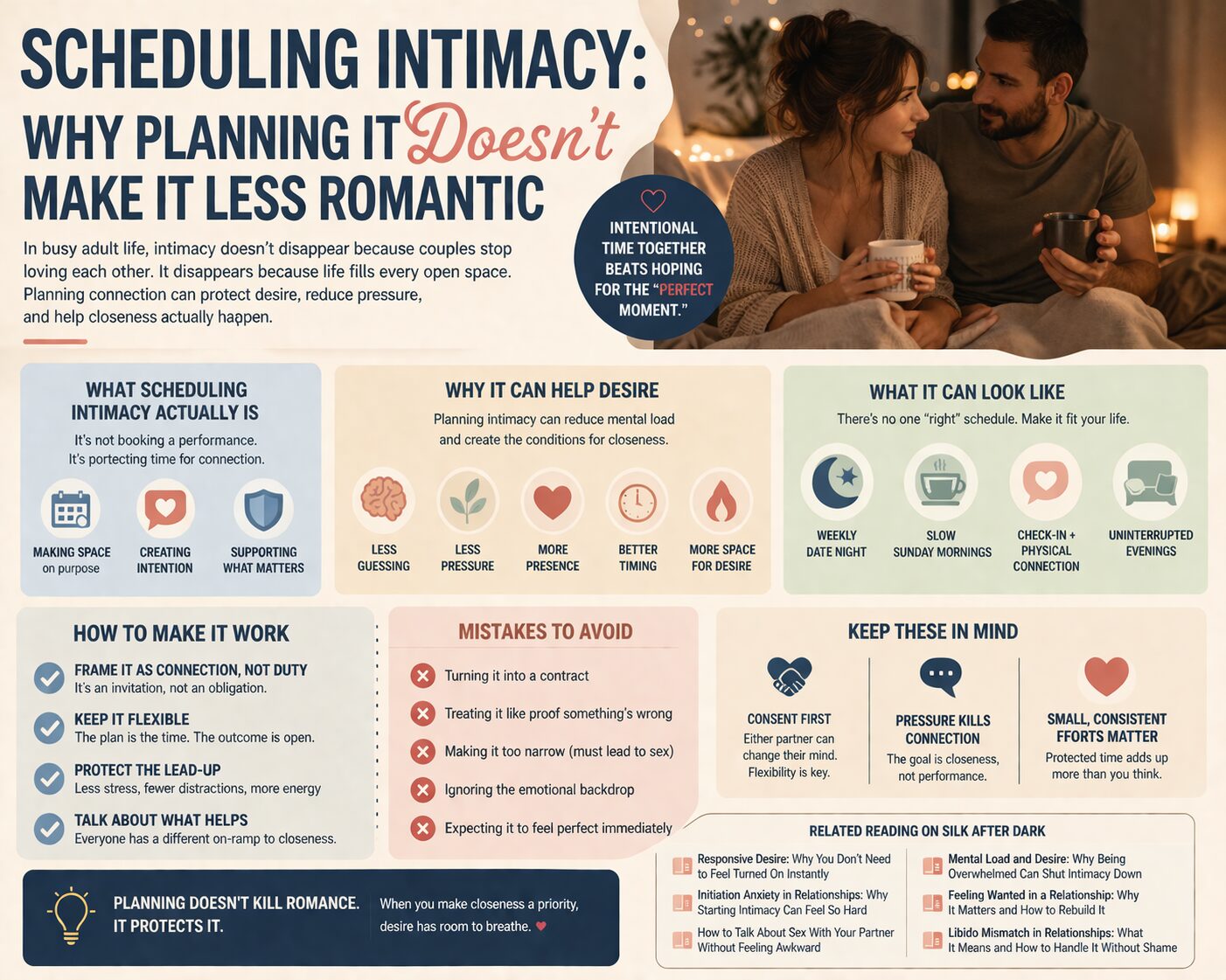
Many couples say they want more spontaneity.
What they often need is more space for closeness to actually happen.
That is why scheduling intimacy can feel so complicated. On one hand, planning connection may sound practical and helpful. On the other hand, many people worry it will feel forced, mechanical, or unromantic. They think, If we have to plan it, doesn’t that mean something is wrong?
Not necessarily.
In adult life, waiting for the perfect moment does not always work. Stress gets in the way. Children need attention. Work stretches late. Mental load builds. Energy disappears. By the time a “spontaneous” opening appears, one or both people may already be tired, distracted, or emotionally flat.
That is why planning intimacy is not always a sign of less desire. Sometimes it is a sign that a couple is trying to protect desire from the chaos of real life.
Quick Answer
Scheduling intimacy does not automatically make it less romantic. In many relationships, it actually helps because it creates time, intention, and emotional space for closeness. Planning connection can reduce stress, lower guesswork, and make intimacy easier to prioritize. The key is treating the plan like an invitation, not an obligation.
Key Takeaways
- Planning intimacy can support connection in busy adult life.
- Scheduled does not have to mean rigid, cold, or forced.
- Many couples feel more relaxed when closeness is protected on purpose.
- The goal is not performance. The goal is creating space for connection.
- Scheduled intimacy works best when it stays flexible, respectful, and pressure-free.
Table of Contents
- What scheduling intimacy actually means
- Why spontaneity is not the only healthy model
- Why planning can help desire
- What this looks like in real relationships
- How to schedule intimacy without making it awkward
- Mistakes that make it worse
- Consent, flexibility, and emotional safety
- When to look deeper
- FAQ
- Final takeaway
1) What Scheduling Intimacy Actually Means
Scheduling intimacy does not mean booking a robotic performance.
It means intentionally protecting time for connection instead of hoping it magically appears when life is already crowded. That connection may include affection, closeness, flirting, touch, emotional reconnection, or sexual intimacy. The important part is the intention behind it.
In other words, scheduling intimacy is less about controlling the outcome and more about protecting the opportunity.
That distinction matters. Many people hear “scheduled intimacy” and imagine pressure, expectations, and a strict script. A healthier version is much softer. It sounds more like, “Let’s make room for us,” not “We must perform on command.”
2) Why Spontaneity Is Not the Only Healthy Model
Culture loves the idea of effortless passion.
Movies, shows, and social media often make intimacy look immediate, perfectly timed, and always naturally arising at the exact right moment. Real relationships rarely work like that for long.
Adult life changes the environment around desire.
- people get busier
- mental load grows
- stress affects energy
- sleep gets worse
- initiation starts feeling riskier
- desire becomes more contextual
That does not mean intimacy is broken. It often means the conditions around intimacy have changed.
This is one reason scheduling can be helpful. It accepts reality instead of pretending life still runs on unlimited time, low stress, and constant spontaneity. For many couples, intentionality is not the opposite of romance. It is how romance survives adulthood.
3) Why Planning Can Help Desire
Planning can help because desire often needs support.
For some people, intimacy becomes easier when there is less uncertainty. They know time is protected. They know closeness is not being squeezed into the final exhausted ten minutes of the day. They know the relationship is being treated as important, not as an afterthought.
Planning can also reduce several common problems at once:
- less guessing about timing
- less initiation anxiety
- less disappointment around missed moments
- more emotional preparation
- more room for responsive desire to grow
This is especially important in long-term relationships where desire may not always appear instantly. When a couple creates space in advance, it becomes easier for connection to build gradually instead of depending on sudden perfect chemistry.
If that sounds familiar, this topic connects closely with Responsive Desire: Why You Don’t Need to Feel Turned On Instantly and Initiation Anxiety in Relationships: Why Starting Intimacy Can Feel So Hard.
4) What This Looks Like in Real Relationships
Scheduled intimacy does not look the same for every couple.
For one relationship, it may mean setting aside one evening a week for uninterrupted closeness. For another, it may mean planning slower mornings, child-free time, or even a standing habit of reconnecting physically before the week gets too overloaded.
Sometimes the schedule is very explicit. Sometimes it is more like a shared ritual.
- a Friday night with phones away
- a Sunday morning for cuddling and closeness
- a check-in night focused on emotional and physical reconnection
- a plan to leave enough energy for each other instead of only for tasks
The key point is not that every planned moment leads to sex. The key point is that the relationship gets protected time instead of leftover time.
That difference can feel huge.
5) How to Schedule Intimacy Without Making It Awkward
Frame it as connection, not duty
The tone matters immediately. If one partner hears, “We need to schedule sex because things are bad,” the idea may feel clinical or heavy. A softer frame works better.
Try language like:
- “I want us to protect time for closeness.”
- “Life has been loud, and I miss us.”
- “Can we make more intentional space for connection?”
Leave room for more than one outcome
This is essential. If the scheduled time becomes a fixed obligation, pressure rises fast. A better approach is to protect time for intimacy in a broad sense, while letting the exact form stay open.
That might include:
- talking
- touch
- cuddling
- flirting
- emotional reconnection
- sexual intimacy if both people genuinely want it
That flexibility helps scheduled intimacy feel inviting instead of demanding.
Make the lead-up easier
Many intimacy problems begin before intimacy even starts. One partner is exhausted. The house is chaotic. The mind is full. Nothing feels settled enough to relax into closeness.
So if you want planned intimacy to work, support the conditions around it too.
- finish key tasks earlier
- reduce distractions
- share the mental load
- avoid leaving connection for the most depleted moment of the day
This is where Mental Load and Desire: Why Being Overwhelmed Can Shut Intimacy Down becomes especially relevant.
Talk about what helps each of you arrive
Not everyone can switch into intimacy instantly. Some people need emotional closeness first. Others need calm, affection, privacy, or time to transition out of task mode.
Ask questions like:
- “What helps you feel open?”
- “What makes planned intimacy feel supportive instead of pressured?”
- “What tends to shut you down before we even begin?”
Those answers often matter more than the schedule itself.
6) Mistakes That Make It Worse
Mistake 1: Turning the schedule into a contract
The fastest way to damage the idea is to make it feel mandatory. Protected time should create opportunity, not obligation.
Mistake 2: Treating planning as proof the relationship is failing
That interpretation adds shame before the idea even has a chance to help. In many cases, planning is simply a mature response to real life.
Mistake 3: Making it too narrow
If the scheduled time is defined only as “sex must happen now,” tension usually rises. Broader connection tends to work better.
Mistake 4: Ignoring the emotional backdrop
If resentment, pressure, or feeling unwanted are already present, planning alone may not solve the issue. The emotional pattern underneath still needs attention.
This is where Feeling Wanted in a Relationship: Why It Matters and How to Rebuild It and How to Talk About Sex With Your Partner Without Feeling Awkward can help.
Mistake 5: Assuming it should feel perfect immediately
Like any new relationship habit, this may feel a little unfamiliar at first. That does not mean it is wrong. Sometimes couples need time to make it feel natural.
7) Consent, Flexibility, and Emotional Safety
This part matters the most.
Scheduled intimacy should never remove consent or flexibility. It should support connection, not override real feelings. That means either person should still be able to slow down, redirect, or say no without the relationship collapsing into guilt or punishment.
Healthy planned intimacy sounds like:
- “Let’s protect time for us.”
- “We can see how we feel when the time comes.”
- “No pressure for a specific outcome.”
- “I want this to feel good for both of us.”
When couples hold the plan lightly and respectfully, the time often feels safer. When the schedule becomes a duty, desire usually shrinks.
8) When to Look Deeper
Sometimes scheduling helps quickly. Other times, resistance to it reveals a deeper issue underneath.
It may be worth looking more closely if:
- one partner hears all planning as pressure
- the relationship already feels emotionally distant
- desire has changed suddenly or dramatically
- stress, burnout, or resentment are very high
- body image, initiation anxiety, or feeling unwanted are part of the pattern
- the couple keeps planning time, but connection still feels blocked
In those situations, the issue may not be scheduling itself. It may be the wider emotional and physical context around intimacy.
If stress is central, Stress and Libido: Why Desire Drops When Life Feels Heavy is a good next step. If desire mismatch is the bigger problem, Libido Mismatch in Relationships: What It Means and How to Handle It Without Shame may help more.
FAQ
Is scheduled intimacy unromantic?
Not necessarily. For many couples, it actually creates more room for closeness by protecting time that would otherwise get lost to stress and routine.
Does scheduling intimacy mean the relationship is in trouble?
No. Often it means the couple is being intentional about connection instead of leaving it to chance.
What if one partner hates the idea of planning?
That usually means the conversation needs more softness. It helps to frame the idea around connection, not duty, and to keep the outcome flexible.
Should scheduled intimacy always lead to sex?
No. It works better when the time is protected for closeness in a broader sense, without pressure for one fixed result.
Can planning help responsive desire?
Very often, yes. Some people need time, calm, and connection for desire to build, and planning can create those conditions more reliably.
What if we schedule time and still do not connect?
Then the issue may be deeper than time alone. Stress, resentment, body image, feeling unwanted, or other relationship patterns may also need attention.
Final Take
Scheduling intimacy does not have to make connection feel cold.
In many relationships, it does the opposite. It says, This matters enough to protect.
That is not unromantic. It is intentional.
When couples stop treating planning as failure and start treating it as care, intimacy often feels less fragile and more supported. Not because every planned moment becomes perfect, but because the relationship is finally getting something it needs: real room to breathe.
Related Reading on Silk After Dark
- Initiation Anxiety in Relationships: Why Starting Intimacy Can Feel So Hard
- Responsive Desire: Why You Don’t Need to Feel Turned On Instantly
- Mental Load and Desire: Why Being Overwhelmed Can Shut Intimacy Down
- How to Talk About Sex With Your Partner Without Feeling Awkward
- Feeling Wanted in a Relationship: Why It Matters and How to Rebuild It
- Stress and Libido: Why Desire Drops When Life Feels Heavy
- Libido Mismatch in Relationships: What It Means and How to Handle It Without Shame
- Arousal vs Desire: Why They Are Not the Same Thing
- Body Image and Desire: How Self-Consciousness Can Affect Intimacy
- Hormones and Libido: What Changes and Why
- Browse all articles on Silk After Dark