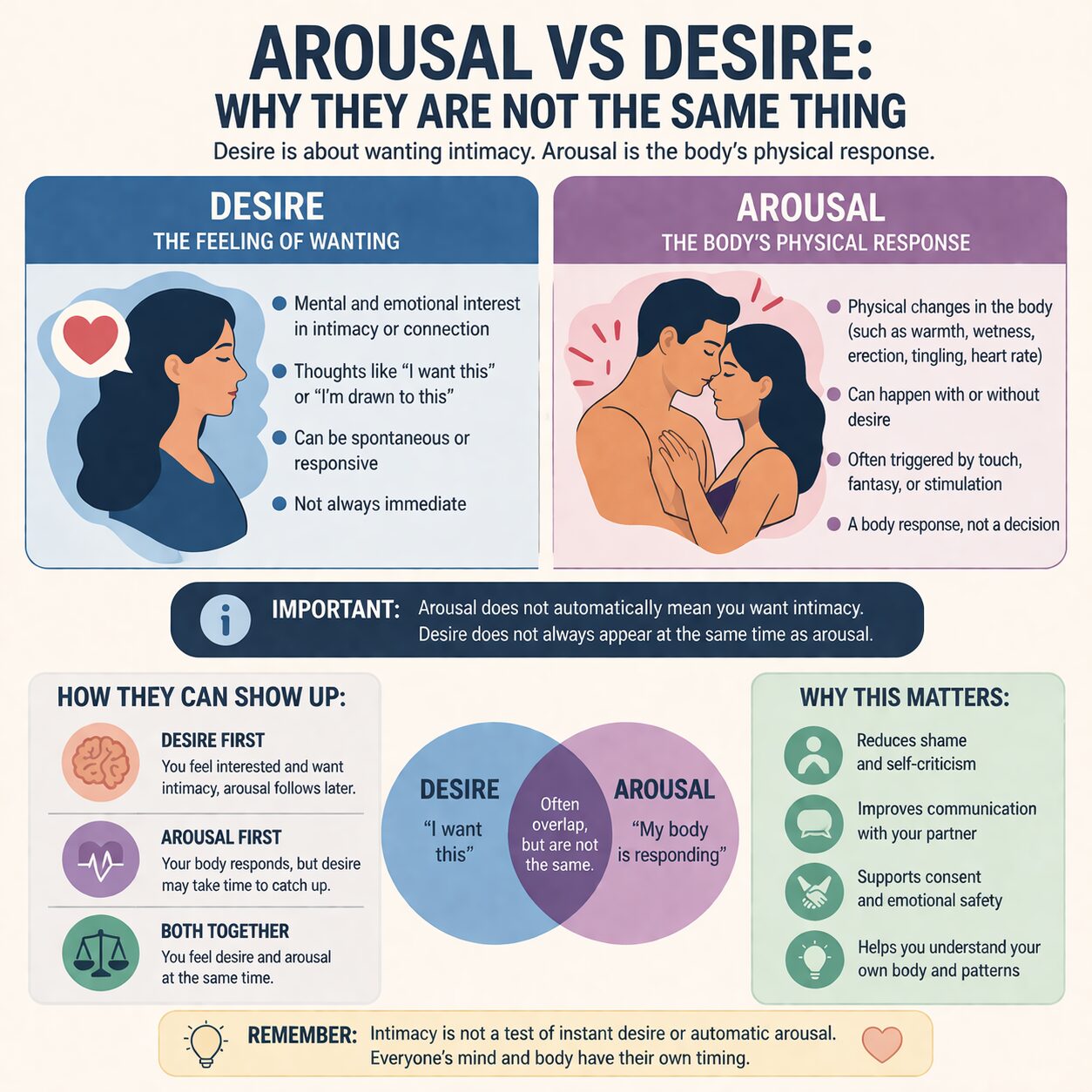
Many people use the words arousal and desire as if they mean the same thing.
They do not.
That confusion causes more stress than people realize. Someone may think, “If my body responds, I must want this.” Another person may think, “If I care about my partner, I should feel desire first.” In reality, the body and the mind do not always move in the same order, and they do not always send the same message.
That is why understanding the difference between arousal and desire matters so much.
It can reduce shame. It can improve communication. It can help people stop misreading their own experiences. And in relationships, it can make intimacy feel far less confusing.
Quick Answer
Arousal and desire are related, but they are not the same thing. Desire is the feeling of wanting intimacy or being interested in it. Arousal is the body’s physical response. Sometimes they happen together. Sometimes desire comes first. Sometimes arousal comes first. And sometimes one shows up without the other.
Key Takeaways
- Desire is about wanting. Arousal is about physical response.
- The mind and body do not always move in perfect sync.
- You can feel desire without strong physical arousal right away.
- You can also experience physical arousal without genuinely wanting intimacy.
- Understanding the difference helps reduce shame, pressure, and misunderstanding.
Table of Contents
- What desire means
- What arousal means
- Why people confuse the two
- How they can show up in different orders
- What this looks like in real relationships
- Mistakes that make it more confusing
- Consent, body response, and emotional safety
- When to look deeper
- FAQ
- Final takeaway
1) What Desire Means
Desire is the sense of wanting intimacy.
It is the mental and emotional interest in closeness, connection, touch, or sexual experience. In simple terms, desire is about interest. It is the part that says, “I want this,” “I am open to this,” or “I feel drawn toward this.”
For some people, desire feels spontaneous. It appears quickly and clearly. For others, it is more responsive. It grows after connection, relaxation, affection, or emotional safety begin to build.
That matters because many adults assume desire should always be immediate. If it is not, they worry that something is wrong. Often, nothing is wrong at all. Desire may simply have a different rhythm.
2) What Arousal Means
Arousal is the body’s response.
It includes the physical signs that the body is reacting to stimulation, anticipation, touch, fantasy, or context. Arousal is not just one sensation. It is a process of physical activation.
In other words, arousal is about what the body is doing, while desire is about what the person wants.
Those two things often overlap, but they are not identical. That is exactly why this topic matters. People often assume body response is a perfect truth signal. It is not always that simple.
3) Why People Confuse the Two
Part of the confusion comes from culture.
People are often taught a very simplified script: attraction happens, desire appears, the body responds, and everything moves together in one clear line. Real life is often much messier.
Sometimes a person feels mentally interested before their body catches up. Sometimes the body responds before the mind feels fully engaged. Sometimes stress blocks desire even though affection is still present. Sometimes someone cares deeply about their partner but feels too mentally overloaded to access interest at first.
When people do not know arousal and desire can separate, they start making harsh interpretations.
- “If I wanted this, my body would react faster.”
- “If my body reacted, that must mean I wanted it.”
- “If I do not feel instant desire, something must be broken.”
Those assumptions usually create more confusion, not more clarity.
4) How They Can Show Up in Different Orders
There is no single correct sequence.
Sometimes desire comes first
A person may feel mentally interested, emotionally open, and drawn toward intimacy before strong physical response begins. In that case, desire leads and arousal follows.
Sometimes arousal comes first
A person may notice physical activation before they fully register desire. That does not automatically mean anything is wrong. It simply means the body responded before the mind put the full emotional meaning around it.
Sometimes desire grows later
This is where many people experience confusion. They may not feel strong interest at the very beginning, but after affection, safety, touch, or connection build, desire starts to appear. That pattern is one reason responsive desire is so important to understand.
Sometimes one appears without the other
This is the point many adults were never taught clearly enough. Physical response does not automatically equal emotional willingness. And emotional interest does not always guarantee strong body response right away.
That difference is important for self-understanding, for communication, and especially for consent.
5) What This Looks Like in Real Relationships
In relationships, confusion between arousal and desire can create all kinds of misunderstandings.
- One partner may think lack of instant desire means lack of attraction.
- Another may feel guilty because their body is slower to respond.
- Someone may assume body response means everything is fully okay, even when emotional comfort is missing.
- A couple may argue about “wanting” when the real issue is stress, timing, or different desire patterns.
This is one reason some people feel broken when they are not broken at all. They may simply be expecting their body and mind to behave in a narrow way they were taught to see as “normal.”
It is also why better language can help so much. When people understand that desire and arousal do not always arrive together, they often become more patient with themselves and with each other.
6) Mistakes That Make It More Confusing
Mistake 1: Treating body response as full consent
This is one of the biggest misunderstandings. A physical response does not automatically mean someone wants intimacy or feels emotionally comfortable.
Mistake 2: Assuming desire must always be instant
For many adults, it is not. Especially in long-term relationships, stressful seasons, parenthood, burnout, or busy life phases, desire may need more context and more time.
Mistake 3: Turning slow response into self-criticism
People often panic too quickly. They think, “Why am I not reacting the right way?” That stress usually makes everything harder.
Mistake 4: Ignoring the wider context
Arousal and desire are shaped by more than attraction. Stress, sleep, hormones, mental load, body image, resentment, health changes, and relationship quality can all affect how easily they show up.
Mistake 5: Expecting one fixed pattern forever
What feels easy in one life season may feel different in another. That does not automatically mean something is wrong. Sometimes it simply means the context has changed.
7) Consent, Body Response, and Emotional Safety
This section matters the most.
A body response is not the same as consent.
Consent is about willingness, choice, and emotional agreement. It is about what someone wants, not only about what their body happens to do. That is why understanding arousal vs desire is not just useful. It is essential.
A respectful relationship makes room for that complexity.
- Someone can care about their partner and still not want intimacy in a given moment.
- Someone can have some physical response and still not feel emotionally comfortable.
- Someone can need more time, more safety, or more connection before genuine desire appears.
Healthy communication sounds like:
- “What are you feeling right now?”
- “Do you want this?”
- “We can slow down.”
- “You do not have to force anything.”
That kind of language protects both clarity and safety.
8) When to Look Deeper
Sometimes the difference between arousal and desire is simply educational. Once people understand it, they feel relieved.
Other times, the topic points to something deeper.
It may be worth looking more closely if:
- desire has changed suddenly
- physical response feels consistently difficult or distressing
- stress, burnout, or mental overload are high
- body image struggles are interfering with presence
- resentment or relationship tension have built up
- hormones, medication, pain, or other health factors may be involved
In those cases, the answer may not be “try harder.” It may be understanding the wider system around intimacy more clearly.
FAQ
What is the difference between arousal and desire?
Desire is the mental or emotional sense of wanting intimacy. Arousal is the body’s physical response. They often overlap, but they are not the same thing.
Can you feel desire without strong arousal right away?
Yes. Some people feel mentally interested before their body fully catches up.
Can the body respond without real desire?
Yes. Physical response does not automatically equal emotional willingness or consent.
Why is this so confusing for so many people?
Because many people were taught a simplified version of intimacy where the mind and body always move together. Real life is often more complex.
Does this connect to responsive desire?
Very often, yes. Some people do not feel strong desire instantly, but interest grows after connection and context begin.
Can understanding this improve a relationship?
Absolutely. Better language reduces shame, lowers pressure, and helps couples talk more honestly about what they are actually experiencing.
Final Take
Arousal and desire are connected, but they are not interchangeable.
Once people understand that, many things start making more sense. Slow response feels less alarming. Different desire patterns feel less like failure. And body reactions become easier to interpret with more care and less shame.
This is one of those simple distinctions that can change how people understand intimacy completely.
Not because it solves everything overnight, but because it replaces confusion with better language. And better language often becomes the start of better intimacy.
Related Reading on Silk After Dark
- Responsive Desire: Why You Don’t Need to Feel Turned On Instantly
- Libido Mismatch in Relationships: What It Means and How to Handle It Without Shame
- Mental Load and Desire: Why Being Overwhelmed Can Shut Intimacy Down
- Body Image and Desire: How Self-Consciousness Can Affect Intimacy
- Feeling Wanted in a Relationship: Why It Matters and How to Rebuild It
- Stress and Libido: Why Desire Drops When Life Feels Heavy
- Hormones and Libido: What Changes and Why
- Anatomy 101 (Vulva/Vagina, Penis/Testes, Clitoris, Pelvic Floor)
- Sexual Development Across Life Stages (Puberty → Adulthood)
- What Is Sex Education (and What It Is Not)
- Browse all articles on Silk After Dark