
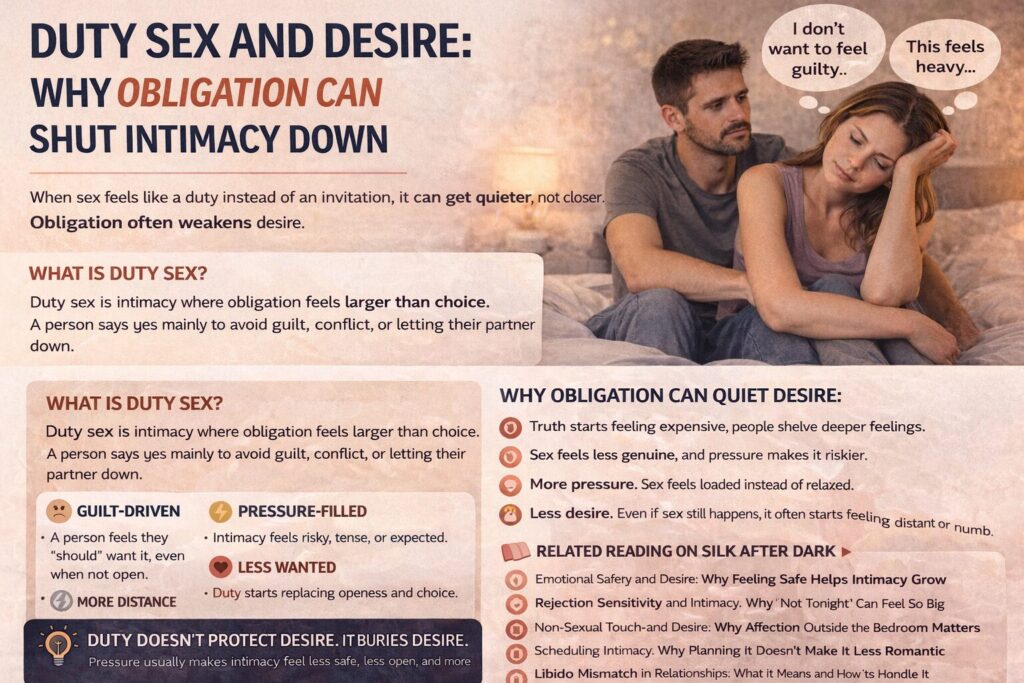
Duty Sex and Desire: Why Obligation Can Shut Intimacy Down
Many people think intimacy problems are mainly about frequency.
Often, the deeper issue is the feeling underneath the frequency.
Sometimes sex is still happening in a relationship, yet something important feels wrong. One person may be showing up physically, but not emotionally. The moment may look like closeness from the outside, yet inside it feels heavy, disconnected, or tense. That is often where obligation enters the picture.
This is what many people mean when they talk about duty sex.
Duty sex is not simply sex that happens in a long-term relationship. It is intimacy driven mainly by pressure, guilt, fear of conflict, or the desire to avoid disappointing a partner. Instead of coming from genuine openness, it comes from obligation.
That difference matters a lot.
When intimacy starts feeling like a task, a responsibility, or something that must be provided to keep the relationship stable, desire usually does not grow. More often, it gets quieter. Over time, obligation can make intimacy feel less safe, less warm, and less honest for both people.
Quick Answer
Duty sex happens when intimacy is driven more by obligation than genuine desire, openness, or mutual willingness. It can damage connection because it turns closeness into pressure instead of choice. In many relationships, desire becomes harder to access when one partner feels they are participating to avoid guilt, conflict, or disappointment rather than because they truly want the moment.
Key Takeaways
- Duty sex is often driven by guilt, pressure, or emotional obligation.
- A person can care deeply about their partner and still feel shut down by obligation.
- Repeated obligation often weakens desire instead of protecting it.
- The issue is not only whether sex is happening, but how it feels emotionally.
- Intimacy usually becomes healthier when choice, honesty, and safety return.
What Duty Sex Actually Means
Duty sex is intimacy that feels more like something owed than something chosen.
That can happen in many ways. A person may say yes because they feel bad saying no. They may worry their partner will feel rejected, become distant, or start a difficult conversation. They may feel responsible for keeping the relationship stable. They may even believe a “good partner” should provide intimacy whether they feel open or not.
On the surface, this can be easy to miss.
The person may not say, “I feel obligated.” They may only say they are tired, stressed, or not fully there. Sometimes they do not even realize how much obligation has entered the relationship until intimacy starts feeling heavy every time it comes up.
That is why the emotional tone matters so much. Two couples may have the same level of sexual frequency, yet the experience can be completely different. In one relationship, intimacy feels chosen and connecting. In another, it feels like pressure wrapped in politeness.
Why Obligation Affects Desire So Strongly
Desire usually needs some sense of freedom.
It grows more easily when a person feels safe, wanted, relaxed, and emotionally able to choose the moment. Obligation creates the opposite state. It adds tension. It adds pressure. It turns closeness into something loaded.
That shift changes the whole experience.
When someone feels they “should” want intimacy, they often become more disconnected from what they actually feel. Instead of noticing desire, they start managing expectation. Instead of asking, “Am I open right now?” they start asking, “How do I avoid hurting my partner?” Over time, that creates emotional distance from their own body and from intimacy itself.
This is one reason duty sex can quietly reduce desire. It teaches the body that closeness is not always restful or welcome. Sometimes it feels like work. Sometimes it feels like emotional maintenance. Sometimes it feels like the price of keeping things calm.
That is a hard environment for desire to grow in.
What This Looks Like in Real Relationships
Duty sex does not always look dramatic.
Often, it shows up in small repeated patterns.
One partner says yes even when they feel flat, just to avoid tension.
Someone agrees because they are afraid of another difficult conversation.
A person stops checking in with their own desire and focuses only on keeping peace.
Intimacy starts happening out of routine, not real openness.
One partner feels increasingly disconnected but does not know how to say it clearly.
Over time, both people usually get hurt in different ways.
The partner participating out of obligation may start feeling shut down, resentful, or quietly numb. The other partner may sense the distance and feel confused, unwanted, or frustrated without understanding why the connection feels so thin.
That is why duty sex is not only a problem for the lower-desire partner. It often hurts both sides. One person feels pressured. The other feels like something real is missing, even if they cannot fully name it.
Why Couples Often Misunderstand It
Many couples focus on the fact that intimacy is happening and miss the emotional reality of how it is happening.
One partner may think, “At least we are still having sex, so the relationship must be okay.” The other may be thinking, “I feel less and less present every time.”
That gap can become painful.
Sometimes the higher-desire partner does not want obligation at all. They want genuine closeness. But because the relationship has become tense around honesty, the lower-desire partner starts saying yes from pressure instead of truth. Then both people end up participating in a pattern neither of them actually wants.
This is also why duty sex often overlaps with other patterns already on Silk After Dark. It can connect with feeling unwanted, initiation anxiety, rejection sensitivity, responsive desire, emotional safety, and mental load. Very often, obligation is not a standalone issue. It grows out of the emotional climate around intimacy.
What Actually Helps
Name the pattern honestly
The first shift is usually language.
Many couples stay stuck because they keep talking only about frequency, not the emotional experience underneath it. A more useful conversation often starts with something like:
“I think intimacy has started feeling pressured for me.”
“I care about us, but I’ve been saying yes when I’m not really open.”
“I don’t want closeness to come from guilt.”
That kind of honesty can feel vulnerable. Still, it is much more repairable than a pattern of silent obligation.
Separate desire from duty
This is essential.
No one can feel genuinely free if the relationship treats intimacy like a responsibility that must be delivered on schedule. That does not mean desire never matters or that frustration is not real. It means desire usually responds better to invitation than obligation.
When couples separate intimacy from duty, they create space for real willingness to come back.
Reduce the emotional cost of honesty
Many people fall into duty sex because saying no feels too expensive.
Maybe the partner becomes hurt, cold, sarcastic, or withdrawn. Maybe the moment turns into a long conversation every time. Maybe guilt fills the room. If honesty has too much emotional cost, people often stop being honest.
That is why a warm, regulated response to “not now” matters so much. It protects trust. It teaches the relationship that truth is safer than performance.
Make room for broader closeness
If sex has become too loaded, some couples need to rebuild connection in less pressured ways first.
That can include:
- affectionate touch
- longer hugs
- emotional check-ins
- cuddling without escalation
- intentional time together
- protected closeness without one fixed outcome
This is where non-sexual touch, emotional safety, and scheduling intimacy can all become useful. Not because they replace sex, but because they reduce pressure and make connection feel possible again.
Ask what intimacy currently feels like
This question is often more useful than “Why don’t you want it more?”
Ask:
- Does intimacy feel connecting or stressful right now?
- Does touch feel safe or loaded?
- What helps you feel genuinely open?
- What makes you feel like you have to perform?
Those answers usually reveal more than another argument about frequency.
Mistakes That Make It Worse
Mistake 1: Treating participation as proof everything is fine
Sometimes a person is showing up physically while feeling emotionally absent. Looking only at behavior can hide the real problem.
Mistake 2: Making honesty too expensive
If saying no leads to guilt, resentment, or emotional punishment, obligation usually grows.
Mistake 3: Treating intimacy like relationship maintenance
Closeness is important, but when sex becomes something a person must provide to keep the relationship calm, desire often shuts down.
Mistake 4: Ignoring the wider pressure pattern
Duty sex rarely appears out of nowhere. It often grows in relationships where stress, rejection sensitivity, poor communication, or emotional safety issues are already active.
Mistake 5: Assuming obligation is better than distance
It may seem like obligation keeps the relationship afloat, but over time it usually creates a different kind of distance.
Consent, Choice, and Emotional Safety
This section matters most.
Duty sex is not the same as mutual, enthusiastic willingness. A person can agree to something while still feeling pressured by guilt, fear, or emotional obligation. That is why consent and emotional freedom need to stay connected.
Healthy intimacy leaves room for real choice.
That means someone can say:
- “I care about you, but I’m not open right now.”
- “I want closeness, but not from pressure.”
- “I need us to make this feel safer again.”
- “I don’t want to keep saying yes from guilt.”
Those are difficult sentences. They are also deeply important.
Real intimacy usually gets stronger when honesty gets safer. When people no longer have to perform openness they do not feel, the relationship has a chance to rebuild something more genuine.
When to Look Deeper
Sometimes this pattern improves quickly once couples start talking more honestly and responding with less pressure.
Other times, duty sex points to a deeper issue.
It may be worth looking more closely if:
- one partner feels consistently numb or resentful around intimacy
- the other feels chronically rejected or confused
- honesty about desire has become hard for a long time
- mental load, burnout, or body image issues are high
- there is an ongoing mismatch in desire
- emotional safety is already low in the relationship
In those cases, the issue may not be solved by trying harder. It may need a wider reset around stress, communication, safety, and the emotional meaning of intimacy in the relationship.
FAQ
Is duty sex always obvious?
No. Often it develops slowly. A person may only realize later that they have been participating from pressure more than desire.
Can duty sex hurt a relationship even if both people mean well?
Yes. Even when nobody is trying to cause harm, obligation can weaken honesty, safety, and real connection over time.
What if I love my partner but intimacy feels like a chore?
That usually means something important needs attention. Love may still be present, but desire may be getting blocked by pressure, stress, resentment, or emotional overload.
What if I’m the partner who senses something is off?
Try focusing less on frequency and more on emotional truth. Ask what intimacy feels like for your partner right now, not only how often it is happening.
Can this get better?
Yes. Many couples improve once obligation is named clearly and the relationship makes more room for honest choice.
Final Take
Duty sex often looks like closeness from the outside.
Inside the relationship, it can feel very different.
When intimacy comes more from obligation than openness, desire usually does not get protected. It gets pushed further away. That is why this topic matters so much. The issue is not only whether sex is happening. It is whether the relationship still feels safe enough for intimacy to be real.
When couples replace pressure with honesty, obligation with choice, and fear with emotional safety, closeness often becomes less heavy and more genuine again.
RELATED READING ON SILK AFTER DARK:
- Emotional Safety and Desire: Why Feeling Safe Helps Intimacy Grow
- Rejection Sensitivity and Intimacy: Why “Not Tonight” Can Feel So Big
- Non-Sexual Touch and Desire: Why Affection Outside the Bedroom Matters
- Scheduling Intimacy: Why Planning It Doesn’t Make It Less Romantic
- Libido Mismatch in Relationships: What It Means and How to Handle It Without Shame
- Mental Load and Desire: Why Being Overwhelmed Can Shut Intimacy Down
- Responsive Desire: Why You Don’t Need to Feel Turned On Instantly
- How to Talk About Sex With Your Partner Without Feeling Awkward