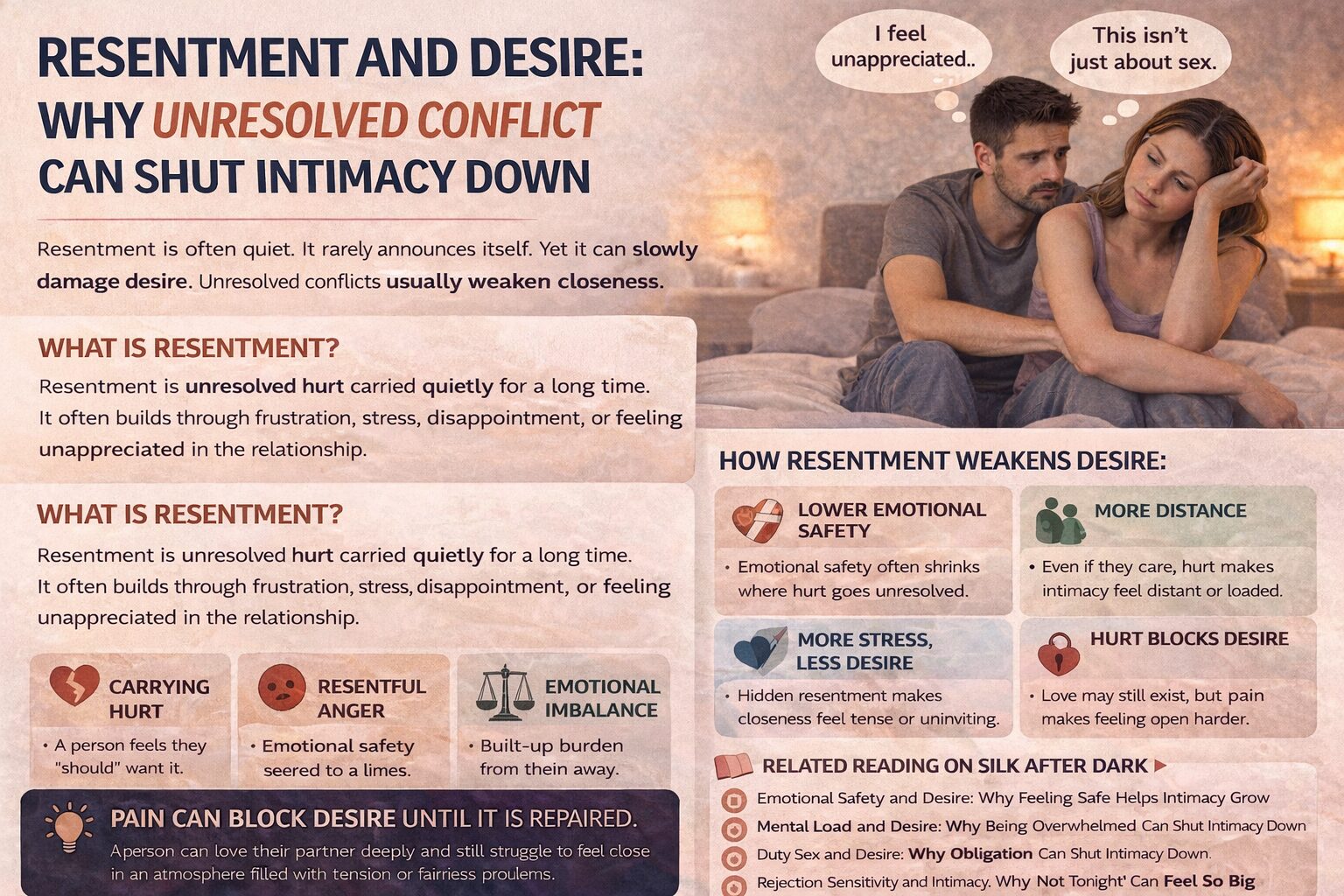
Many couples think desire disappears because attraction disappears.
Very often, that is not the real story.
Sometimes desire fades because too much unresolved hurt has built up between two people. The relationship may still look functional from the outside. Life may still be moving. The couple may still love each other. Yet underneath the routine, there is tension that has never fully been repaired.
That is where resentment becomes so important.
Resentment does not always arrive as one dramatic event. Often, it grows quietly. It builds through repeated disappointments, unresolved arguments, uneven effort, emotional disconnection, broken promises, feeling unsupported, or the sense that one person keeps carrying more than the other. Over time, that emotional weight can change how closeness feels.
When resentment is high, intimacy often becomes harder.
Not because love is always gone.
Not because the relationship is automatically broken.
But because desire usually struggles in an atmosphere filled with anger, disappointment, pressure, and unresolved pain.
Quick Answer
Resentment affects desire because unresolved hurt makes emotional and physical closeness feel less safe, less natural, and less inviting. A person may still care deeply about their partner, yet feel shut down by the emotional weight between them. In many relationships, intimacy becomes difficult not because attraction disappeared, but because too much conflict, disappointment, or imbalance has gone unaddressed.
Key Takeaways
- Resentment can quietly weaken desire over time.
- Unresolved conflict often affects intimacy more than couples realize.
- A person can love their partner and still feel blocked by built-up hurt.
- Pressure for intimacy usually makes resentment worse, not better.
- Repair, honesty, and emotional fairness often matter more than performance.
What Resentment Actually Means in a Relationship
Resentment is hurt that never fully got resolved.
It is the feeling that something important happened, or kept happening, and the relationship did not truly repair it. Sometimes it comes from repeated arguments. Sometimes it comes from emotional neglect. Sometimes it comes from one partner feeling unseen, unsupported, or consistently let down.
What makes resentment difficult is that it does not always look loud.
It can look like irritation.
It can look like emotional distance.
It can look like colder tone, less patience, less affection, or less generosity.
Sometimes it just looks like someone slowly becoming less open.
That is why resentment is easy to miss if couples only look at the surface.
One person may say, “I just don’t feel in the mood lately.”
What they may really mean is, “Something in me still feels hurt, and I don’t know how to relax past it.”
Why Resentment Affects Desire So Strongly
Desire usually needs some sense of goodwill.
It does not need a perfect relationship. It does not need zero stress. But it often needs enough emotional openness that closeness feels welcoming instead of complicated.
Resentment changes that.
When unresolved hurt is sitting in the relationship, physical closeness can start feeling disconnected from emotional truth. A person may think:
- “I’m still angry.”
- “I still don’t feel heard.”
- “I’m doing too much.”
- “You want closeness now, but where were you when I needed support?”
- “I don’t feel emotionally close enough for this.”
That emotional reality matters.
For many people, desire is not only about attraction. It is also about whether the relationship feels warm, fair, respectful, and emotionally safe. If those things feel shaky, the body often notices before the person even has words for it.
That is one reason unresolved resentment can reduce desire so powerfully. It makes closeness feel emotionally expensive.
What This Looks Like in Real Relationships
Resentment-driven intimacy problems do not always look dramatic.
Often, they appear through patterns.
One partner stops initiating.
Affection becomes less natural.
A small disagreement creates a much bigger shutdown than it used to.
Touch starts feeling irritating instead of comforting.
One person begins avoiding closeness without fully understanding why.
Arguments about sex become arguments about everything else.
Sometimes the higher-desire partner feels confused and hurt. They think intimacy is the main problem. Meanwhile, the lower-desire partner feels that the real problem started much earlier.
Maybe they feel unsupported in daily life.
Maybe they feel emotionally dismissed.
Maybe they feel like conflict never gets resolved properly.
Maybe they are still carrying disappointment from many moments the relationship moved past too quickly.
Then intimacy becomes the place where all of that hidden tension shows up.
Why Couples Often Misunderstand It
Many couples talk about the intimacy problem without talking about the resentment underneath it.
One person says, “We’re not connecting anymore.”
The other hears, “You’re failing.”
Then both defend themselves instead of looking at the deeper system.
This is why resentment gets missed so often.
The couple argues about frequency.
But the real issue may be unresolved hurt.
They argue about initiation.
But the real issue may be emotional imbalance.
They argue about whether the relationship still has chemistry.
But the real issue may be that too much disappointment has built up without enough repair.
This is also why resentment often overlaps with other themes in the Silk After Dark cluster. It can connect with mental load, emotional safety, feeling unwanted, rejection sensitivity, duty sex, and scheduling intimacy. In many relationships, resentment is not one separate problem. It is the emotional fog sitting over several other problems at once.
What Actually Helps
Name the hurt directly
Many couples stay stuck because they keep discussing intimacy without naming the deeper resentment.
A more useful conversation often begins with sentences like:
“I think there’s still hurt between us that hasn’t been resolved.”
“I don’t think this is only about desire. I think I’m carrying resentment too.”
“I want us to talk about what still feels unfinished between us.”
That kind of honesty is uncomfortable, but it is more useful than pretending the intimacy problem exists on its own.
Stop treating sex as the repair
This is one of the most important shifts.
Sex does not usually fix resentment.
Pressure for sex usually makes resentment worse.
When one partner already feels emotionally burdened, unsupported, or hurt, asking intimacy to repair the relationship often backfires. It makes closeness feel like another demand instead of a place of real connection.
Repair the emotional layer first.
Take fairness seriously
Resentment often grows where effort feels uneven.
That may mean emotional labor.
Practical responsibility.
Repair after conflict.
Initiation of hard conversations.
Follow-through on promises.
Support during stressful times.
If one person consistently feels they carry more, the relationship usually needs more than reassurance. It often needs visible change.
This is one reason resentment so often overlaps with mental load. A person who feels emotionally and practically alone may not experience intimacy as closeness. They may experience it as one more thing being asked from them.
Create real repair after conflict
Some couples argue often. Others avoid conflict completely. Both patterns can build resentment if nothing truly gets repaired.
Repair means more than ending the argument.
It means understanding what happened.
It means acknowledging impact.
It means showing that the hurt matters.
It means changing something if change is needed.
Without repair, conflict rarely disappears. It just sinks lower and starts shaping desire from underneath.
Talk about emotional meaning, not just physical behavior
It helps to ask:
- What are you still carrying that I may not fully see?
- What has felt unresolved for you lately?
- When did closeness start feeling harder?
- What makes intimacy feel emotionally complicated right now?
Those questions often open the real conversation.
Mistakes That Make It Worse
Mistake 1: Trying to solve resentment by asking for more sex
When hurt is unresolved, more pressure for intimacy rarely creates closeness. It usually creates more tension.
Mistake 2: Minimizing repeated disappointments
Small hurts add up. If one partner keeps hearing, “It’s not a big deal,” resentment often grows faster.
Mistake 3: Acting like attraction should override emotional reality
Love and attraction matter, but many people cannot easily access desire when they feel angry, unsupported, or emotionally disconnected.
Mistake 4: Avoiding conflict to keep peace
Avoidance can look calm on the surface, but it often pushes resentment deeper rather than resolving it.
Mistake 5: Expecting quick repair after long-term hurt
If resentment has been building for a long time, it usually needs more than one conversation to soften. That does not mean repair is impossible. It means repair needs consistency.
Consent, Emotional Honesty, and Safety
This section matters most.
When resentment is present, people often feel pressure to move faster than they actually feel ready for. That pressure can make intimacy feel even less safe.
A healthy relationship makes room for honesty like:
- “I care about us, but I’m still hurt.”
- “I don’t want to fake closeness when something still feels unresolved.”
- “I need repair before I can feel open again.”
- “I want intimacy to feel real, not forced.”
Those are difficult sentences.
They are also deeply important.
Real closeness usually gets stronger when people stop performing openness and start telling the truth about what is blocking it.
That does not mean a relationship should become endlessly analytical. It means honesty has to become safer than pretending.
When to Look Deeper
Sometimes resentment softens once couples finally talk about what has been sitting between them.
Other times, it points to something deeper.
It may be worth looking more closely if:
- one partner feels persistently shut down around intimacy
- arguments keep circling the same themes
- the relationship feels emotionally unfair
- one person feels chronically unsupported
- honesty has become difficult because it leads nowhere
- desire has changed sharply alongside rising tension
In those cases, the issue may not be sexual at its core. It may be relational. The real need may be better repair, clearer accountability, emotional fairness, or a more honest look at how the relationship feels day to day.
FAQ
Can resentment really lower desire?
Yes. For many people, unresolved hurt makes closeness feel less safe, less natural, and less emotionally available.
Does resentment mean the relationship is over?
No. It usually means something important needs repair. Many couples improve when they stop ignoring what has been building underneath.
What if I still love my partner but don’t feel open to intimacy?
That is very common when resentment is involved. Love can still be present even when openness feels blocked.
How do I know if resentment is the real issue?
A common sign is when intimacy feels emotionally complicated, pressured, or disconnected, and the real pain seems to go beyond sex itself.
Should we stop intimacy completely while repairing resentment?
Not necessarily. But closeness usually becomes healthier when honesty increases and pressure decreases. What matters most is that intimacy stays real, not performative.
Can this get better?
Yes. Many relationships improve when built-up hurt is finally named, taken seriously, and genuinely repaired.
Final Take
Resentment does not always announce itself loudly.
Sometimes it simply makes desire quieter.
That is why this issue matters so much. A couple can still care about each other and still feel blocked by unresolved pain. When that happens, the problem is not always attraction. Often, it is the emotional weight sitting underneath the relationship.
The good news is that resentment can be worked with.
Not through pressure.
Not through pretending.
Not by using intimacy to skip past repair.
But through honesty, fairness, real accountability, and the willingness to deal with what has actually been building.
RELATED READING ON SILK AFTER DARK:
- Emotional Safety and Desire: Why Feeling Safe Helps Intimacy Grow
- Mental Load and Desire: Why Being Overwhelmed Can Shut Intimacy Down
- Duty Sex and Desire: Why Obligation Can Shut Intimacy Down
- Rejection Sensitivity and Intimacy: Why “Not Tonight” Can Feel So Big
- Non-Sexual Touch and Desire: Why Affection Outside the Bedroom Matters
- How to Talk About Sex With Your Partner Without Feeling Awkward
- Libido Mismatch in Relationships: What It Means and How to Handle It Without Shame