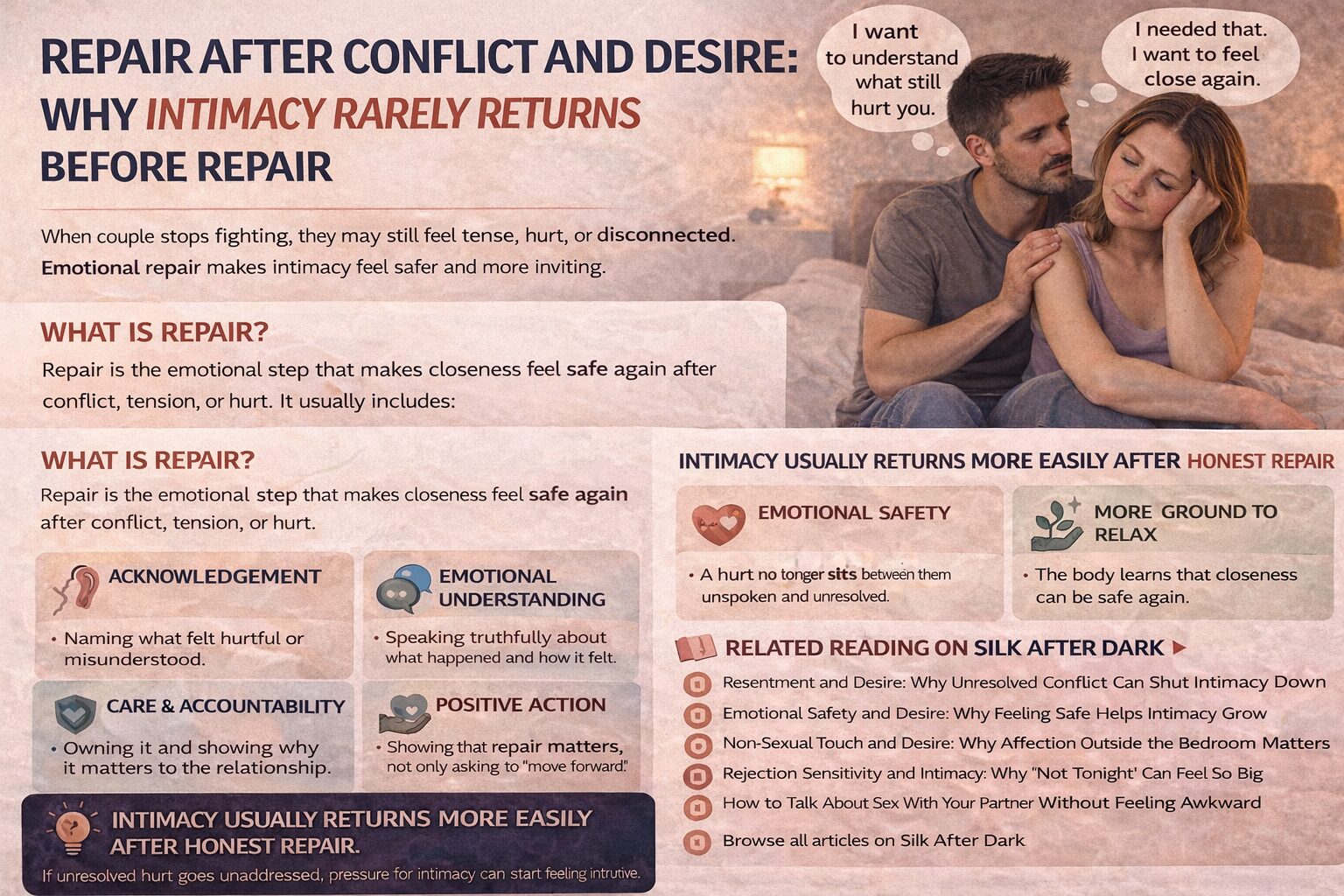
Many people expect desire to return as soon as the argument ends.
In real relationships, it often does not work that way.
A conflict can stop on the surface while still remaining emotionally unfinished underneath. The voices may calm down. The conversation may move on. Daily life may resume. Yet one or both people may still feel hurt, tense, misunderstood, or emotionally far away.
That is where repair becomes so important.
For many couples, intimacy does not become difficult only because conflict happened. It becomes difficult because the conflict never truly got repaired. The disagreement may be over, but the emotional impact is still there. And when that emotional impact is still active, closeness often feels much harder to access.
This matters because many people confuse “the fight is over” with “we’re connected again.”
Those are not always the same thing.
Quick Answer
Repair after conflict matters because desire often returns more easily after emotional closeness is restored, not simply after the argument stops. If one or both partners still feel hurt, unseen, defensive, or distant, intimacy can feel forced or disconnected. In many relationships, desire does not come back through pressure or time alone. It comes back more naturally after honest repair, safety, and emotional reconnection.
Key Takeaways
- An argument ending is not always the same as emotional repair.
- Desire often becomes harder when conflict feels unfinished.
- A person can love their partner and still not feel open after hurt.
- Pressure for intimacy before repair often makes things worse.
- Emotional reconnection usually matters more than trying to “act normal” too quickly.
What Repair Actually Means
Repair is what helps a relationship feel emotionally connected again after tension, hurt, or conflict.
It is not just saying, “Let’s move on.”
It is not just stopping the argument.
And it is not pretending everything is fine because enough time passed.
Real repair usually means something more.
It means both people have some sense that what happened was seen clearly enough, felt honestly enough, and handled with enough care that trust can start settling again. It often includes acknowledgment, emotional understanding, and some sign that the hurt matters.
That is why repair feels different from resolution.
A conflict can be “resolved” logically while still feeling emotionally unresolved.
A couple can agree on the facts and still not feel close.
The problem can look finished in words while still living in the nervous system.
That is exactly why intimacy often struggles after conflict that was technically ended but not truly repaired.
Why Desire Often Drops After Conflict
Desire usually needs some degree of emotional openness.
After conflict, that openness is often reduced.
A person may still be replaying the conversation.
They may still feel blamed.
They may still feel emotionally unsafe.
They may still be carrying sadness, anger, embarrassment, or disappointment.
Even if they want the relationship to feel better, their body may not yet feel relaxed enough for real closeness.
This is one of the most important things couples misunderstand.
They often think the problem is low libido or bad timing, when in reality the problem is emotional residue. The relationship may still feel too tense for desire to feel natural. Instead of closeness feeling inviting, it feels like too much too soon.
That does not mean the relationship is broken.
It often means repair has not caught up yet.
What This Looks Like in Real Relationships
Sometimes this pattern is obvious. Sometimes it is very subtle.
A couple has an argument in the afternoon. By evening, one person wants to reconnect physically. The other feels distant, cold, or shut down and cannot explain why. On paper, the conflict is over. Emotionally, it is not.
In other relationships, the pattern lasts longer.
A fight happens.
The couple moves on quickly.
Nobody wants to “drag it out.”
But affection stays lower for days.
Touch feels less natural.
Desire feels quieter.
One or both people feel slightly guarded without fully naming it.
Then confusion starts growing.
One person thinks:
“Why are we still off?”
The other thinks:
“I’m trying, but something in me still feels closed.”
This is where a lot of intimacy confusion begins. A couple may think they are dealing with a sexual problem when they are actually dealing with an unrepaired emotional rupture.
Why Couples Often Misunderstand It
Many couples are taught how to end conflict, not how to repair after it.
They learn how to stop talking.
How to calm down.
How to drop the subject.
How to keep the peace.
What they do not always learn is how to restore closeness after something painful happened.
That missing step creates trouble.
One partner may think:
“We already dealt with it.”
The other may think:
“No, we stopped talking about it. That’s not the same thing.”
This is especially common in relationships where one person moves on quickly and the other needs more emotional processing. The faster-moving partner may feel frustrated that the issue is “still going.” The slower-moving partner may feel pressured to reconnect before they are ready.
That mismatch often makes intimacy harder.
It also connects closely with the other Silk After Dark themes already on the site. If unresolved hurt is already building, this overlaps strongly with Resentment and Desire. If honesty feels emotionally costly, it overlaps with Emotional Safety and Desire. If one partner feels a simple pause means deeper disconnection, it may also connect with Rejection Sensitivity and Intimacy.
What Actually Helps
Acknowledge that stopping the fight is not the same as repairing it
This shift alone helps many couples.
Instead of asking, “Why aren’t we back to normal yet?” it helps to ask, “Did we actually repair what happened?”
That question changes the whole conversation.
Name what still feels unfinished
Many people stay stuck because they try to jump back into closeness without naming the gap.
It often helps to say things like:
“I know the argument is over, but I still don’t feel fully settled.”
“I want closeness with you, but I think I still need repair first.”
“I’m not trying to punish you. I just don’t feel emotionally back yet.”
That kind of honesty is usually much more helpful than forcing warmth that is not real yet.
Focus on understanding, not only resolution
A lot of couples rush toward fixing the problem and skip over understanding the emotional impact.
Repair often needs more than agreement.
It needs some version of:
- “I get why that hurt.”
- “I see your side more clearly now.”
- “I don’t want to treat your reaction like a problem to manage.”
- “I understand why you’re still affected.”
Feeling understood often softens the body much faster than being logically told the issue is finished.
Give closeness a gentler path back
After conflict, some people do not want zero connection. They just do not want immediate sexual pressure.
This is where softer reconnection helps:
- a calmer conversation
- a real apology
- sitting close
- a longer hug
- non-sexual affection
- reassurance without demand
This is one reason non-sexual touch matters so much in relationships. It can help rebuild safety without asking the body to leap straight into desire.
Make room for different recovery speeds
Not everyone returns to closeness at the same pace.
Some people regulate quickly.
Others need more emotional processing before they feel open again.
That difference is not automatically a compatibility problem. It becomes a problem when one person treats the other’s pace like disobedience, overreaction, or rejection.
Respecting different recovery speeds usually makes repair easier, not slower.
Mistakes That Make It Worse
Mistake 1: Pushing for intimacy before repair
This is one of the fastest ways to make the emotional gap bigger. If one person still feels hurt, pressure for closeness often feels like emotional skipping, not reconnection.
Mistake 2: Acting like time alone should fix it
Sometimes time helps. But if the hurt was meaningful, time without repair often only turns pain into distance.
Mistake 3: Treating lingering hurt like a character flaw
If one partner says, “You’re too sensitive,” “You’re dragging this out,” or “You should be over this already,” safety usually drops even more.
Mistake 4: Using sex to avoid the real conversation
Sometimes couples try to reconnect physically because talking feels harder. That may create temporary closeness, but if the emotional layer stays unresolved, the distance often returns.
Mistake 5: Confusing peace with connection
A quiet room is not always a connected room.
Silence is not always repair.
And routine is not always closeness.
Consent, Emotional Readiness, and Safety
This part matters a lot.
After conflict, people often feel pressure to reconnect physically before they feel emotionally ready. That usually makes desire harder, not easier.
A healthy relationship makes room for both truth and warmth.
That can sound like:
- “I care about you, but I’m not fully open yet.”
- “I want us to reconnect, just not by skipping over what happened.”
- “I’m not rejecting you. I still need emotional repair.”
- “Let’s get close in a way that feels safe first.”
That kind of language protects both consent and connection.
It also prevents one of the most painful patterns in relationships: when one person feels pressured to provide intimacy while still carrying hurt. That usually does not create real closeness. It creates emotional confusion.
When to Look Deeper
Sometimes repair gets easier once couples simply recognize that repair is needed.
Other times, repeated conflict shutdown points to something deeper.
It may be worth looking more closely if:
- the same arguments keep repeating
- one partner never feels fully repaired after conflict
- intimacy often disappears for long stretches after disagreements
- apology and accountability feel weak or inconsistent
- resentment is building over time
- one person feels emotionally unsafe being honest
In those situations, the issue may not just be conflict style. It may be trust, fairness, emotional safety, or a relationship pattern where hurt keeps getting reopened without enough true repair.
FAQ
Is it normal to feel less desire after an argument?
Yes. For many people, conflict reduces emotional openness, which can make desire feel quieter or harder to access.
What if my partner wants intimacy quickly after conflict and I don’t?
That is common. People recover at different speeds. The important part is talking about emotional readiness without turning it into blame.
Does repairing after conflict mean talking forever about every issue?
No. Repair is not endless discussion. It is enough understanding and care that the relationship starts feeling safe and connected again.
Can non-sexual closeness help after conflict?
Yes. For many couples, gentle affection and emotional warmth help reconnect the relationship without making things feel too intense too soon.
What if we always act normal after a fight but still feel distant?
That usually means the conflict stopped on the surface, but the emotional layer may not have been fully repaired.
Can this get better?
Yes. Many couples improve when they stop expecting desire to return automatically and start paying more attention to emotional repair.
Final Take
Intimacy often struggles after conflict not because love disappeared, but because repair did not fully happen.
That is an important difference.
When couples expect desire to return before trust, understanding, and emotional softness return, they often create more confusion. But when they slow down, repair honestly, and make room for real reconnection, closeness usually has a much better chance to come back naturally.
Not because they forced it.
Not because they ignored what happened.
But because they actually repaired what was sitting between them.
RELATED READING ON SILK AFTER DARK:
- Resentment and Desire: Why Unresolved Conflict Can Shut Intimacy Down
- Emotional Safety and Desire: Why Feeling Safe Helps Intimacy Grow
- Non-Sexual Touch and Desire: Why Affection Outside the Bedroom Matters
- Rejection Sensitivity and Intimacy: Why “Not Tonight” Can Feel So Big
- How to Talk About Sex With Your Partner Without Feeling Awkward
- Duty Sex and Desire: Why Obligation Can Shut Intimacy Down
- Mental Load and Desire: Why Being Overwhelmed Can Shut Intimacy Down